

“DONNE DEL MARMO” / CLAUDIA FORMICA SCULPTURE PARK

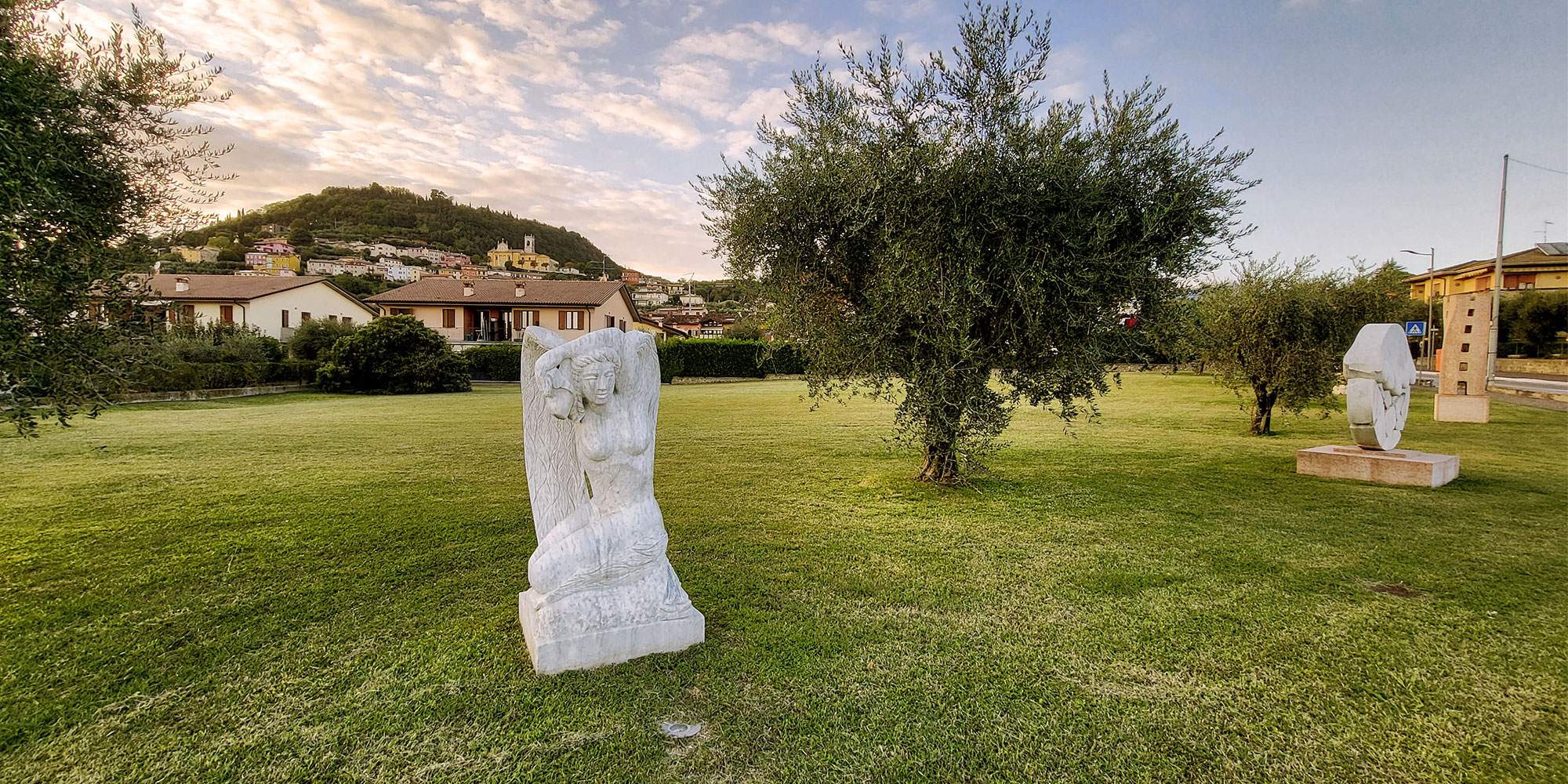
To fill a gap left by the absence of any street or place names honouring women in the Municipality of Cavaion Veronese, the local administration has chosen to dedicate the park between Via Pozzo dell’Amore and Via Cà Nove to women — in particular to the “Donne del Marmo” (Women of Marble) and to Claudia Formica (1903–1987), the sculptor who created Cavaion’s War Memorial. The aim is to highlight women’s intelligence and creativity, especially within the stone industry, a sector of great importance to the local economy in which many women work today. This “female toponymy” project also offers an opportunity to bring some order to the town’s history by recovering and showcasing works of art produced during the Marble Symposia held by the Municipality, in partnership with local companies, between 1998 and the early 2000s. These sculptures have remained silent and often hidden; bringing them to light also creates a meaningful link with the Cavaion War Memorial in Piazza della Chiesa, made by the sculptor Claudia Formica in the 1940s. This naming project, promoted by the Municipality of Cavaion, was carried out in collaboration with the national association “Donne del Marmo”, the CTG group “El Preon” of Cavaion-Affi, and the Marble Technical School of the Istituto Salesiano San Zeno.
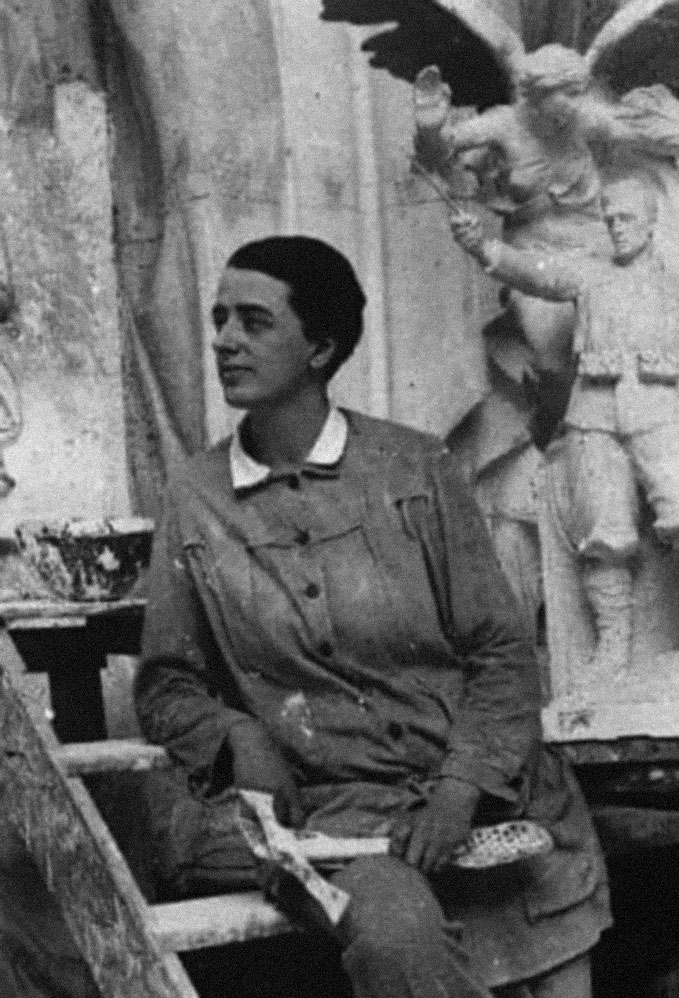
CLAUDIA FORMICA (Nizza Monferrato 1903 ‒ Turin 1987)
One of the most important Piedmontese sculptors and ceramicists of the twentieth century, and a fiercely independent figure, Claudia Formica succeeded in establishing herself professionally and earning her living through her own work in sculpture, a discipline traditionally regarded as a male preserve. Born in the southern part of the Asti region, she moved to Turin to study at the Accademia Albertina di Belle Arti under masters such as Edoardo Rubino and Giovanni Riva. She was among the first women to attend the sculpture courses of the Turin academy. From 1927 onwards she made her name as one of the leading early modellers for the renowned Turin manufactory Lenci. For the brand she created a number of ceramic figurines that enjoyed enormous commercial and critical success, including the well-known Confidenze series. In 1929 she opened her own independent ceramics workshop. From 1929 to 1942 he took part in all the regional exhibitions organised by the Sindacato Fascista di Belle Arti (the Fascist Union of Fine Arts), and showed his work in Florence and Naples. He also exhibited at the Venice Biennale in 1940 and 1950. Her sculptures stood out for their marked plastic vitality, solid modelling and keen psychological insight. Her favourite subjects included childhood and adolescence, the female figure and sacred art. She produced significant public and funerary monuments, among them the bronze infantryman for the War Memorial of Incisa Belbo (now Incisa Scapaccino, 1927). It is precisely this work that provides the link with Cavaion Veronese, home to a “twin” war memorial in marble by the same sculptor. Recent historical research by Guido Galvanini and Daniela Zanetti, which led to the book La curiosa storia del monumento ai caduti di Cavaion Veronese, published by the CTG group “El Preon” (2024), brought to light the connection between the two commemorative works and the final placement of the Cavaion monument in Piazza della Chiesa on 28 August 1960. After years of relative obscurity, Claudia Formica has been rediscovered thanks to gender-focused historical studies, notably the research of Chiara Lanzi. Most of her plaster casts and works are now preserved and open to the public at the “Claudia Formica” Gipsoteca (Plaster Cast Gallery), housed in the historic Palazzo Crova in Nizza Monferrato.
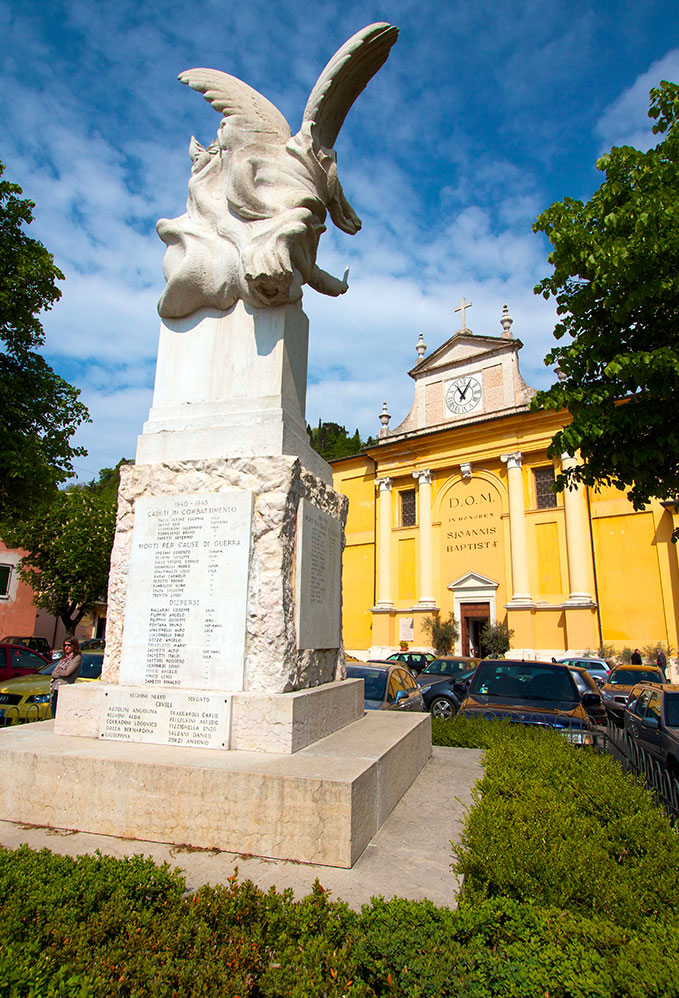
Photo: Paul Crespel
WAR MEMORIAL OF CAVAION VERONESE
The War Memorial of Cavaion Veronese, dedicated to the memory of the fallen of all wars, stands in the church square, one of the most panoramic spots in the village. As with many monuments in the area, the story of its construction began after the war, thanks to the local section of the ANCR (National Association of Combatants and Veterans), which started working on the project and raising funds among the townspeople to build it. The original plan called for a commemorative obelisk. However, a curious series of events, brought to light only recently through the discovery of some documents belonging to the ANCR section, has revealed the true story of the sculptural group. It is a marble copy of the bronze War Memorial by the sculptor Claudia Formica, made for the Municipality of Incisa Belbo, today Incisa Scapaccino (province of Asti), and placed in the town hall square on 6 November 1927. During the war, in 1942–43, the Piedmontese sculptor Claudia Formica sent a plaster copy of the Incisa Scapaccino monument to the G. Piatti Marble Workers' Cooperative in Sant'Ambrogio di Valpolicella so that the statuary group could be reproduced in marble. This marble copy was intended to replace the bronze original, which was due to be melted down as part of the "Cannons for the Fatherland" campaign. Owing to a complicated series of events, the bronze statue of Incisa Scapaccino was never requisitioned for melting, and so the marble copy was left abandoned in the yards of the Sant'Ambrogio Cooperative. In the second half of the 1950s, the President of the Cooperative, Beniamino Vittorio Cecchini, offered the sculptural group to the Cavaion committee and acted as intermediary with the owner of the work, the sculptor Claudia Formica. She agreed to the sale and made proposals for the pedestal so that the monument would be harmoniously proportioned and correctly positioned in the church square. The War Memorial of Cavaion was inaugurated on 28 August 1960
From: Galvanini G. – Zanetti D., "La curiosa storia del Monumento ai Caduti di Cavaion" (The Curious Story of the Cavaion War Memorial), CTG El Preon, 2024